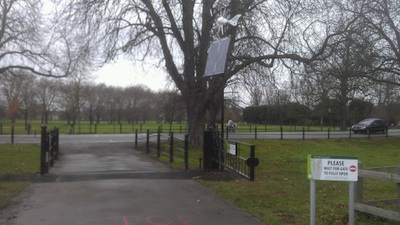
The ongoing saga of disputes over parking and vehicular access to Midsummer Common in Cambridge took a bizarre turn at the West Central Area Committee on the 5th of January 2012.
Cllr Rodrick Cantrill announced the council’s intention to prosecute two buildings on the common: the Fort St. George pub, and the Midsummer House restaurant. Cllr Cantrill explicitly said he had taken a decision “to prosecute against properties not individuals”.
I have no idea what is going on here but Cllr Cantrill may be seeking to break new legal ground. As I understand it, to-date, only legal entities: real people and companies, have ever been prosecuted for anything in the UK.
The statement was prompted by a public question from Mr Lawton, who asked what the council was doing to enforce the rules against driving and parking on the common. Mr Lawton was asked if he had any follow-up point to make and responded to say he didn’t understand what Cllr Cantrill was proposing, this prompted laughter from all present including the other councillors on the committee.
Liberal Democrat Cllr Cantrill, who is Cambridge City Council’s executive councillor responsible for green spaces, had started his response to the question by highlighting the new gate which he has had been installed. Cantrill was heckled by residents who pointed out the contraption had not been working at all at first, and was now being left open between from 7 to 10am every morning as its solar and wind power sources weren’t sufficient to enable it to open and close for each morning delivery to the businesses on the common.
Cllr Cantrill enraged representatives of both the Friends of Midsummer Common and the Brunswick and North Kite Residents Association by saying they had opposed a gate of any kind. This is something he repeatedly alleges and they repeatedly deny.
Cantrill said he had chosen his windmill and solar powered contraption over the residents’ preferred option of a rising curb on the grounds of aesthetics. I thought this was very odd as the windmill is very visually intrusive and a rising curb would probably have been all but invisible to almost everyone except those driving head on towards it when in was a raised position. Cllr Cantrill said he had considered wider interests than the Friends of Midsummer Common and the residents associations had when coming to his decision. Ironically Cantrill claimed a rising curb would have made the area look like a car park. The representatives of those organisations present objected to the implication being made by Cllr Cantrill that they were philistines or did not care about the appearance of the common.
Cantrill had brought one of his officers, Alistair Wilson the council’s “Head of Green Spaces” to the meeting. Mr Wilson told the committee the council was to pursue “injunctions against properties”, which perhaps sounds slightly more in the realms of reality than prosecuting inanimate objects, but was still clunky phrased if injunctions preventing parking or access for certain purposes are in-fact being proposed.
Cllr Cantrill told the committee his new gate was part of a “stepped approach” the council was adopting. Mr Wilson said the council was planning to come up with a formal policy statement on how it was to take enforcement action against those illegally driving and parking on the common.
Cantrill told the committee that the council had done a land registry search and had concluded from the results that the Fort St. George pub had no right of access across the common. Mr Higgs of the Friends of Midsummer Common reported that Mr Baxter, the chairman of the Friends of Midsummer Common, understood that properties on or adjoining common land automatically had rights of access across it. (This appears to be based on the judgement in Bakewell Management Limited v. Brandwood and others; which has been interpreted in a DEFRA guidance note on the subject).
Wheel Clamping
A councillor asked if wheel clamping was permitted on the common; and if it was for this purpose considered public or private land. (Wheel clamping is to be banned on private land if c54 of the Protection of Freedoms Bill becomes law.)
Councillors noted their legal department was taking a very long time to get back to them on this question. Cllr Cantrill agreed. Mr Lawton said that everything in relation to parking on Midsummer Common appeared to be taking glacial amounts of time and wondered if the issue would be resolved before he, and everyone else, was dead.
Ombundsman Complaint
No update was given on the progress of Mr Baxter’s complaint to the Local Government Ombudsman over the councils failure to act on parking and driving on the common.
Policing
I thought it notable that despite the police being present they were not asked to comment, or act, on the illegal driving and parking on the common.
Planning
The Friends of Midsummer Common also complained the council’s planning public access system was broken and as a result they were not being kept informed of planning applications on and near the common despite registering their area of interest. They reported this was a deterioration in the service which they had previously received from the council.
See Also
- My article following the Friends of Midsummer Common 2011 AGM – includes discussion of vehicles on the common and a report on the contribution from the manager of the Fort St. George Public House.
10 responses to “Properties to be Prosecuted Over Parking and Driving on Midsummer Common”
“and was now being left open between from 7 to 10am every morning as its solar and wind power sources weren’t sufficient to enable it to open and close for each morning delivery to the businesses on the common.!”
You couldn’t make it up could you?
Cllr Cantrill’s windmill has been moved, towards the middle of the common.
This wasn’t mentioned at the last West/Central Area Committee. There is no planning application for the work listed on the council’s website.
The Cambridge News have an article on the latest developments they are reporting a spider clogged up the mechanism.
At the West/Central Area Committee on the 28th of February 2013 councillors were told there was no update on the planning situation in relation to the windmill. They still claim not to know, despite asking their officers, if it required planning permission (this is something I asked about at the area committee and Cllr Cantrill has now failed to provide an answer at a number of subsequent meetings)
During the open forum session at the meeting a member of the public said the gate intended to control access onto Midsummer Common had been open to-date in 2013. He said that Cllr Cantrill had promised to have it fixed by the 1st of March 2013 or he would eat a hat. The speaker, and another member of the public brought hats labelled “eat me” which they brandished. The speaker offered to cook a hat for Cllr Cantrill in any way he liked.
Cambridge’s Liberal Democrats have form in offering to eat hats; the ex council leader, ex councillor Ian Nimmo-Smith offered to eat his over the loss of the council’s Icelandic Investments if all the money didn’t come back.
The meeting’s chair, Cllr Reiner, read out a message from Cllr Cantrill, who was unexplainedly absent (councillors present refused to comment on rumours he was in Eastleigh for the by-election there).
This message from Cllr Cantrill stated that he is “looking at alternative ways to power the windmill”.
This bizarre message was queried by the public who en-mass expressed astonishment.
Cllr Reiner re-read the message and confirmed that was what what Cllr Cantrill had written in an email sent the previous day.
I assume there has been a mistake.
It may be Cllr Cantrill has not understood the problem; people are not complaining that the windmill isn’t going round fast enough, or that it doesn’t move when there is no wind. The complaint is that the gate is not working.
If Cllr Cantrill is seriously considering finding a new source of energy, other than the wind, to power his windmill I think he must have gone bananas.
What could be be thinking of: a huge pair of bellows to blow on it? Perhaps powered by electricity (maybe hydro?) or maybe a petrol or diesel generator?
My suggestion is that any alternative source of energy, such as mains electricity, be used directly to power the gate, rather than to power the windmill.
It was my colleague Roger Chatterton of BruNK who said that the gate had been permanently open since last November. The council has given up trying to keep it working. The large number of visitors and hence gate operations per day together with the vagaries of the renewable energy source have resulted in flat betteries on too many occasions. The odd thing is that we were always told that getting mains electricity to the gate was prohibitively expensive, but recently it seems that has changed. Very mysterious. We have to wonder whether we have been correctly informed of the situation all along.
On other fronts Councillor Cantrill has presided over a period when little or no maintenance and improvement has seemed to take place on Midsummer Common.
Many paths edges are in a very bad state, due to neglect in some cases and on some paths due to council vehicles daily causing critical damage.
Periodic meetings between Friends of Midsummer Common, BruNK residents’ association and council officers have still been attended and suggestions made on this and other matters but now without any hope of improvements actually being made. I have refused to attend these anymore as there is no point in making the same points year after year, seemingly gaining council officer agreement but then no action taking place. It seems there is a brickwall somewhere in the council that stops things happening.
The Cambridge News has an article on the latest antics; it states:
I think it was very clear at the meeting that what the meeting heard was that Cllr Cantrill is seeking an alternative power source for the windmill. What I think has happened is the Cambridge News has corrected the obvious mistake out of a desire not to make Cllr Cantrill look silly, because that might damage relationships between the newspaper and the council which the newspaper relies on.
The news was happy to report that Cllr Cantrill had been asked to eat his hat by residents after failing to fulfill his commitments so perhaps they just thought he’d been made to look silly enough for one article already.
At the West Central Area Committee on the 20th of June 2013 the new executive councillor for green spaces, Cllr Reiner, stated the windmill had been installed without the required planning permission. She stated the windmill would either be reduced to a height where it does not require permission, or permission would be applied for.
The windmill has now been removed from the post:
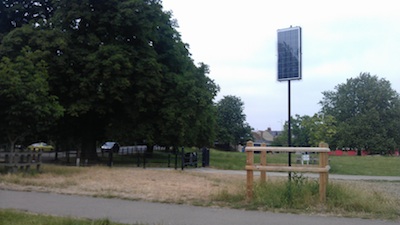
For more on the gate saga see
http://www.rtaylor.co.uk/friends-of-midsummer-common-agm-2015.html#comment-111216